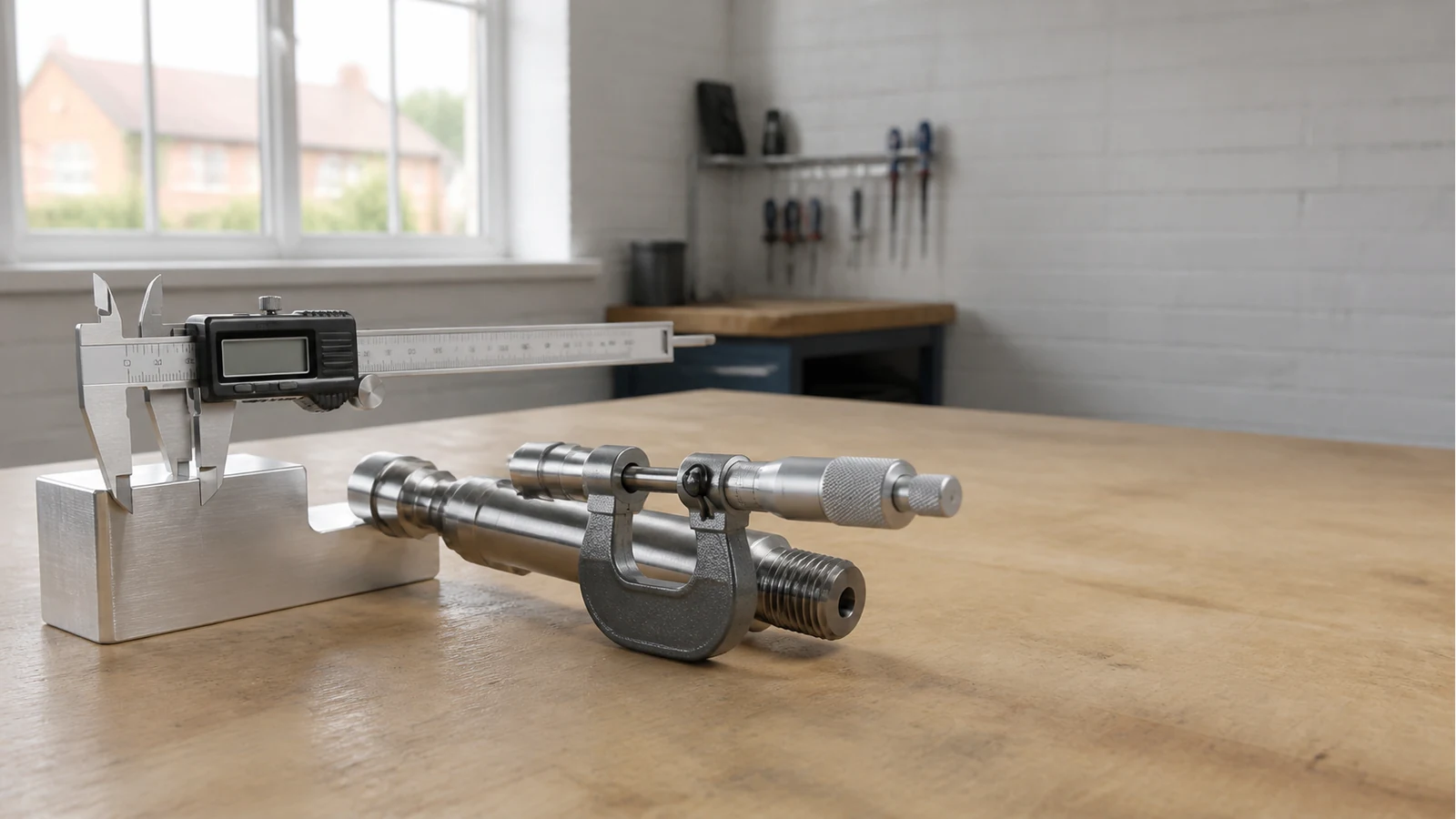
Digital Caliper Vs Micrometer Uk Workshop
A digital caliper is usually the better everyday workshop tool when you need fast outside, inside, depth and step measurements. A micrometer is the safer choice when the job depends on a close outside diameter, a thin thickness reading or a tolerance where jaw flex and hand pressure could scrap the part.
The quick decision
| Workshop job | Better first tool | Why |
|---|---|---|
| Checking stock size, spacers, brackets or 3D printed parts | Digital caliper | Fast, versatile and good for several feature types. |
| Final check on a shaft, pin or ground diameter | Outside micrometer | The frame and ratchet/friction feel give better control of pressure. |
| Finding a hole size quickly before drilling or turning | Digital caliper | Inside jaws are convenient for workshop checks, with care around jaw depth. |
| Signing off a press fit or close bearing journal | Micrometer, and often gauges | A general caliper is too easy to tilt or squeeze inconsistently. |
Why the answer is not just accuracy on the box
UK tooling guides such as the Cutwel caliper and micrometer comparison present calipers as versatile checking tools and micrometers as the more specialised choice for controlled outside measurement. The point is not that a caliper is useless; it is that a caliper puts more of the result in the operator's hands.
A caliper has long jaws, several measuring faces and a sliding beam. That makes it fast and flexible, but it also means a heavy squeeze, a burr on the work, or a reading taken near the jaw tips can move the number. A micrometer is slower, but its frame, spindle and pressure device reduce that variability for the specific feature it is built to measure.
Match the tool to the risk
For a garage machinist, model engineer or small repair bench, a good 150 mm digital caliper is often the tool that gets picked up twenty times a day. Use it for roughing checks, set-up comparisons, depth checks, step checks and parts where the tolerance leaves room for ordinary workshop handling.
Move to a micrometer when the drawing tolerance is tight enough that a few hundredths of a millimetre matter to the finished result. The Protool guide to vernier calipers and micrometers makes the same practical distinction: calipers are quick general measuring tools, while micrometers are used when tolerance risk is higher.
Do not buy a second caliper to solve a micrometer problem
If you already own a serviceable digital caliper and the problem is final size on turned shafts, another premium caliper may not be the best spend. Buy or borrow the right range of outside micrometer first. If the problem is that your cheap caliper is sticky, hard to read, unreliable when damp, or missing depth and step capability, then upgrading the caliper can make sense.
Common UK workshop examples
Mini-lathe users can use a caliper to check stock diameter before turning, compare shoulder positions and measure overall lengths. For the final diameter of a close-fitting steel pin, use a micrometer. Woodworkers can use calipers for router-bit height checks and board thickness, but do not need a micrometer unless they are doing metalwork or very controlled component matching.
Small QC benches should define which dimensions are caliper checks and which require micrometers, gauges or formal inspection equipment. That prevents a cheap speed habit turning into a quality argument with a customer.
When a general caliper is still the right next step
If your current need is everyday outside, inside, depth and step measuring in a garage or workshop, a sealed stainless digital caliper can still be the practical first tool. For that use case, see the Nanka Pro digital caliper product details before you decide whether you need a specialist gauge instead.